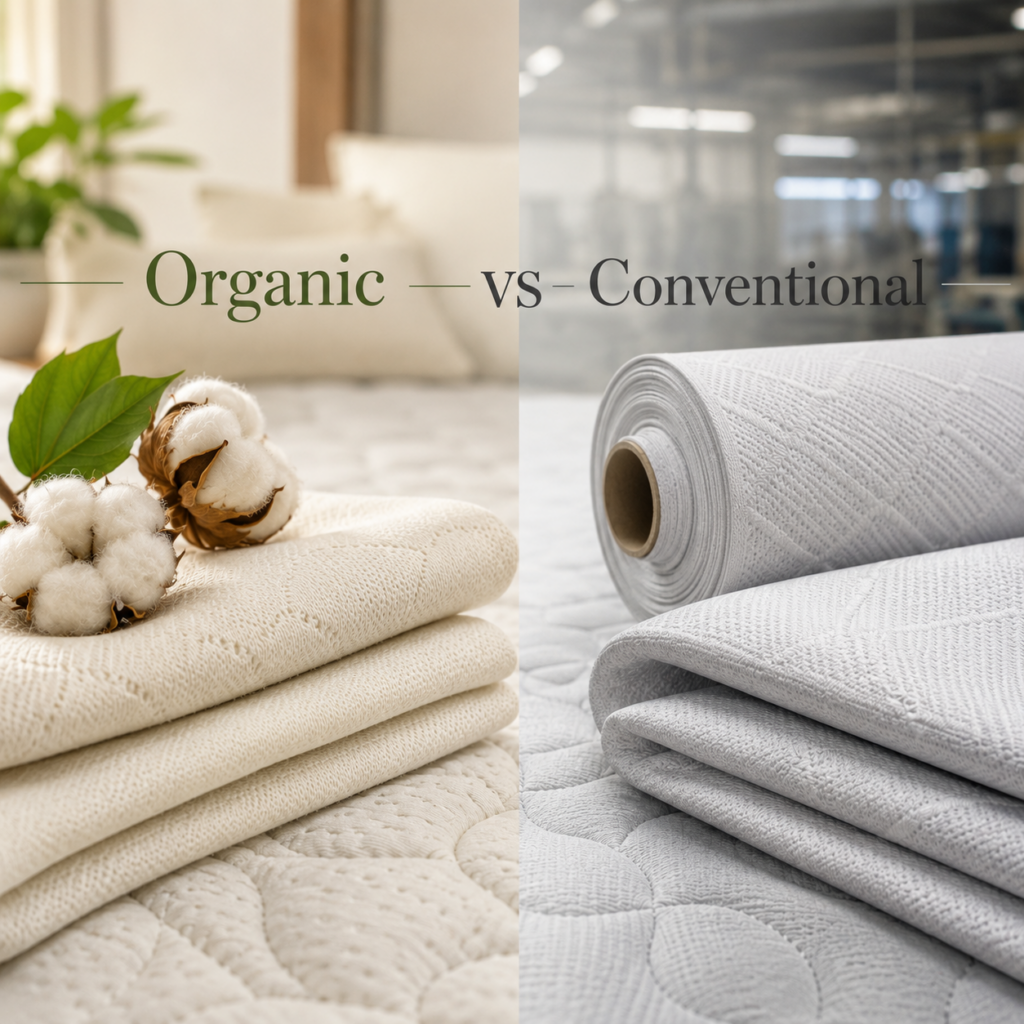
Organic mattress fabric typically costs 20 to 40 percent more than conventional fabric, driven by lower agricultural yields, separate processing requirements, and certification overhead. GOTS-certified organic fabric must contain at least 95 percent certified organic fibre and restricts processing chemicals across the entire supply chain, while conventional fabric carries no such restriction. The right choice depends on the target market’s actual willingness to pay the premium, not on organic being categorically better.
Sleep brands considering an organic product line usually start by researching the environmental and health arguments for organic cotton, which are well documented and genuinely meaningful. What gets less attention, and what actually determines whether the line succeeds commercially, is the sourcing side: what the fabric will cost, what certification actually requires, and where the premium can or cannot be passed on to the end customer. This is the conversation a sustainability lead or product development manager needs to have before committing budget, not after.
Why organic fabric costs more, specifically
The price gap between organic and conventional cotton fibre is real and consistent enough to plan around. Organic cotton fibre typically trades at a meaningful premium over conventional fibre, generally in the range of 20 to 40 percent depending on grade, origin, and market conditions in a given season. That gap is not a markup applied for the organic label. It reflects three separate cost drivers that show up at different points in the supply chain.
Organic farming prohibits synthetic pesticides and fertilizers, which generally results in lower yields per acre compared to conventional growing methods, often cited in the range of 20 to 30 percent lower. Farmers growing organic cotton also invest more labour in manual weed control and soil management to compensate for the inputs they cannot use. Beyond the field, organic fibre has to be kept separate from conventional fibre at every stage of ginning, spinning, and milling to prevent contamination, which requires dedicated equipment and production runs rather than shared capacity. Finally, certification itself carries ongoing audit and documentation costs that get built into the price of the finished fabric.
What GOTS certification actually requires, and what it does not
GOTS, the Global Organic Textile Standard, is the certification most sourcing teams encounter first, and it is worth understanding precisely rather than treating as a single checkbox. A textile labelled simply organic under GOTS must contain at least 95 percent certified organic fibre. A lower tier, labelled made with organic materials, requires a minimum of 70 percent. These are meaningfully different claims, and a buyer evaluating a supplier’s organic fabric should ask which tier applies before assuming full organic content.
GOTS certification also extends beyond the raw fibre. It restricts the chemicals permitted during dyeing, finishing, and processing across the entire supply chain, which is part of why GOTS-certified fabric costs more than fabric made from organically grown fibre that was then processed using conventional chemistry. A separate standard, OCS, the Organic Content Standard, takes a narrower approach, verifying the presence and traceable chain of custody of organic material without imposing the same processing restrictions GOTS requires. Buyers sometimes treat these two certifications as interchangeable, which they are not. A fabric carrying OCS certification has verified organic fibre content, but it has not necessarily been processed under GOTS’s chemical restrictions.
Performance differences that actually matter, and the ones that do not
A common misconception among brands new to organic sourcing is that organic certification itself determines how a fabric performs or feels. It does not, at least not directly. Fibre length, yarn quality, and weave or knit construction determine softness, durability, and hand feel far more than whether the cotton was grown organically. A well-constructed conventional fabric using long-staple fibre will outperform a poorly constructed organic fabric using short-staple fibre, even though the organic fabric carries the more marketable label.
Where organic processing does create a genuine, measurable difference is in chemical exposure. Conventional fabric finishing commonly involves treatments such as formaldehyde-based wrinkle resistance, chemical softeners, and optical brighteners, none of which are permitted under GOTS-certified organic processing. For brands marketing toward chemically sensitive customers, nurseries, or healthcare applications, this distinction is the actual product benefit, separate from any softness or durability claim.
Where the cost premium can realistically be recovered
The commercial question a sustainability lead needs to answer before launching an organic line is whether the target customer segment will actually pay enough of a premium to cover the higher fabric cost, plus margin. Organic and sustainably produced textiles broadly command retail price premiums, with figures in the range of 15 to 30 percent cited across sustainable product categories, which can offset some but not necessarily all of a 20 to 40 percent fibre cost increase, depending on how the rest of the product’s cost structure is built.
This is also where market positioning matters more than the fabric itself. A premium sleep brand already selling at a price point that absorbs higher input costs is in a very different position than a value-tier brand trying to add an organic line without disrupting its existing price architecture. The fabric cost math is the same in both cases. The ability to pass that cost through to the customer is not.
Verifying organic claims before committing
Because the organic cotton market has grown quickly, verification has become a genuine concern for buyers, not just a compliance formality. A GOTS or OCS claim should come with a specific license or scope certificate number that can be checked against the certifying body’s public database, along with documentation of which components of the fabric the certification actually covers. A supplier who can produce this without hesitation is operating differently from one who references certification generally without specific, checkable documentation.
This verification step matters more for organic claims than for most other fabric specifications, because the cost and reputational consequences of an unverified organic claim reaching a retailer or end customer are higher than for most other sourcing mistakes.
Deciding whether an organic line makes sense
None of this is an argument against organic sourcing. It is an argument for treating the decision as a sourcing and commercial question rather than a purely values-driven one. A brand that understands exactly what premium it is paying, what certification tier it is actually buying, and what its own customer base will pay in return is in a far stronger position than one that commits to an organic line on the strength of the environmental argument alone and discovers the margin math afterward.
For a sustainability lead preparing a business case internally, the most useful next step is usually to get a real cost comparison between a specific organic and conventional construction at the GSM and fibre quality the brand actually needs, rather than working from general market figures.
If you are building a business case for an organic product line, we can put together a side-by-side cost and certification comparison for your specific fabric construction, so the numbers in your proposal are based on a real quote rather than industry averages.
Frequently Asked Questions
How much more expensive is organic mattress fabric than conventional fabric?
Organic cotton fibre typically carries a 20 to 40 percent cost premium over conventional fibre, driven by lower agricultural yields, separate processing requirements to prevent contamination, and certification overhead. The premium on finished fabric can vary depending on construction and additional processing.
What is the difference between GOTS and OCS certification?
GOTS certifies organic fibre content of at least 95 percent and restricts processing chemicals across the entire supply chain. OCS verifies organic fibre content and chain of custody but does not impose the same processing restrictions, meaning OCS-certified fabric may still be processed using conventional chemistry.
Does organic cotton mattress fabric perform better than conventional fabric?
Not inherently. Durability, softness, and hand feel are determined primarily by fibre length, yarn quality, and weave or knit construction, not by organic certification itself. The clearest performance difference is reduced chemical exposure from restricted processing under GOTS certification.
Can a brand pass the organic fabric premium on to customers?
Often only partially. Sustainable and organic products can command retail premiums commonly cited in the 15 to 30 percent range, which may not fully offset a 20 to 40 percent fibre cost increase depending on the brand’s overall cost structure and price positioning.
How can a buyer verify that mattress fabric is genuinely GOTS certified?
Request the specific license or scope certificate number and check it against the certifying body’s public database, along with documentation of exactly which components of the fabric the certification covers, rather than relying on a general claim of organic certification.