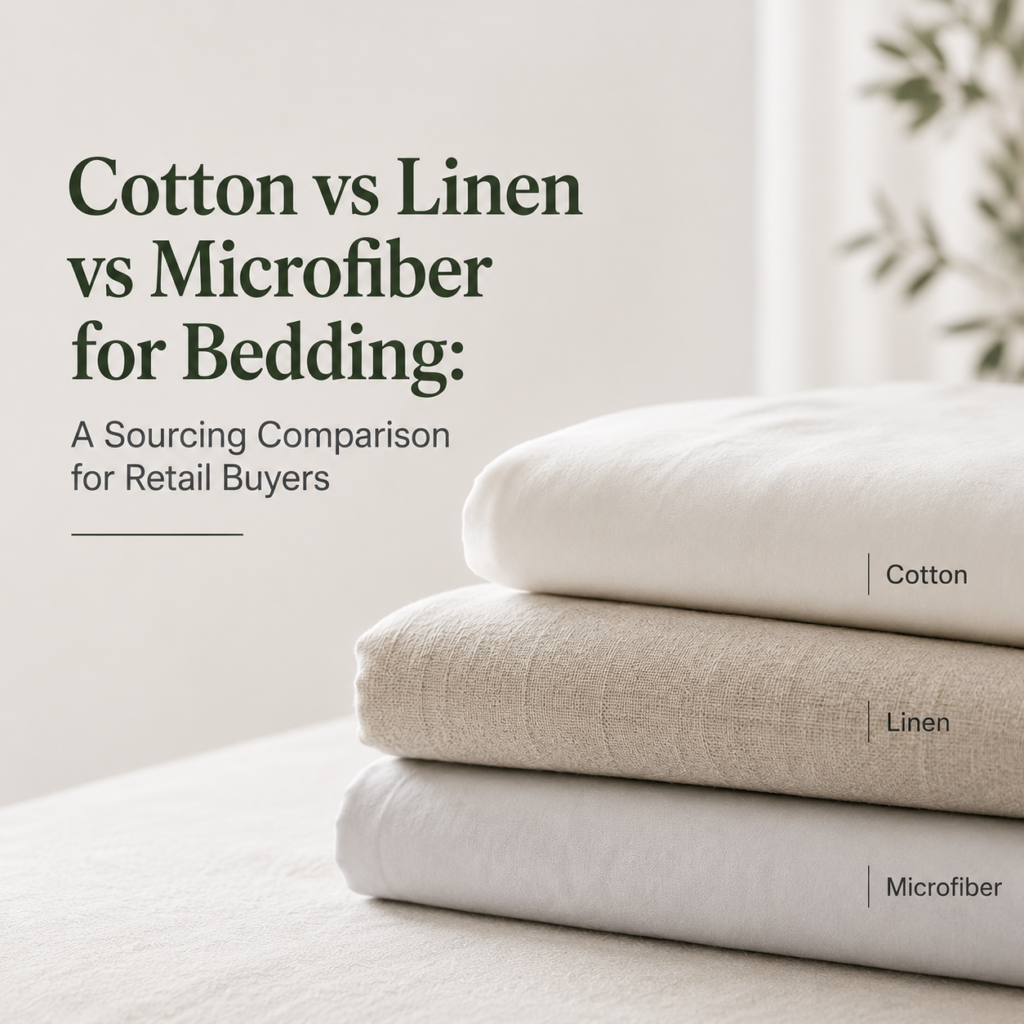
Cotton offers the best balance of softness, affordability, and easy care for mid-market bedding assortments. Linen costs more upfront but lasts roughly twice as long and breathes significantly better, making it the stronger choice for premium or hot-climate positioning. Microfiber is the lowest-cost, most wrinkle-resistant option, suited to value tiers and high-turnover applications like guest rooms, but trades away breathability and long-term durability to get there. Most retail assortments use more than one fiber, assigning each to the price tier and use case it actually serves.
A retail buyer building out a bedding assortment rarely needs to pick one fiber and standardize across the whole line. The more useful question is which fiber belongs in which tier of the assortment, and why, since cotton, linen, and microfiber are not interchangeable substitutes competing on the same axis. Each one wins clearly on a different combination of cost, durability, and comfort, which is exactly why most successful bedding programs carry more than one.
Cotton: the dependable mid-market anchor
Cotton remains the default fiber for a reason. It is immediately soft from the first use, unlike linen, which needs a break-in period before it reaches peak comfort. It is easy to care for, tolerating machine washing, standard detergents, and tumble drying without the special handling linen sometimes benefits from. This combination of immediate comfort and low-maintenance care is exactly what most mid-market retail buyers need for a core sheet program that has to perform consistently across a wide range of end customers with varying laundry habits.
Within cotton, weave and fiber quality matter more than most buyers initially expect. Percale, a crisp one-over-one-under weave, suits a cooler, lighter positioning, while sateen’s smoother, slightly warmer hand feel suits a more premium-feeling product at a comparable price point. Long-staple cotton, including Egyptian and Pima varieties, costs more but resists pilling and holds up to repeated washing noticeably better than standard short-staple cotton, which matters for a buyer trying to reduce return and complaint rates on a core program.
Linen: higher cost, longer life, and a real breathability advantage
Linen, made from flax fiber, costs more than cotton at the same retail tier, largely due to lower fiber yield per acre and more labor-intensive processing. What that higher price buys is measurable: linen’s hollow fiber structure and characteristically open weave give it meaningfully better airflow than cotton, which is why linen has become the default fabric for brands building a cooling or hot-climate product positioning. Linen also tends to outlast cotton by a wide margin, commonly cited in the range of two to three times the service life under comparable use, because flax fiber is unusually strong and, unlike most fibers, actually gains strength when wet.
This longer lifespan changes the total cost of ownership calculation in linen’s favor more than the higher sticker price initially suggests. A buyer modeling cost per year of use, rather than just landed unit cost, often finds linen closing most or all of the price gap with cotton once expected replacement cycles are factored in, which is a useful argument for a premium-tier product story built around value over time rather than just upfront price.
The tradeoff buyers should set accurate expectations around is texture. Linen typically feels rougher than cotton on first use and softens progressively over months of washing, eventually developing a drape and softness that takes longer to reach than cotton’s immediate comfort. Pre-washed or stonewashed linen shortens this break-in period considerably, which is worth specifying explicitly if a brand wants to avoid early customer complaints about initial texture.
Microfiber: the value and high-turnover specialist
Microfiber, typically made from fine polyester or nylon fibers, is the most cost-effective of the three and the most resistant to wrinkling, since synthetic fiber does not crease the way natural fiber does. Its tight weave also tends to make it more abrasion-resistant under frequent washing than lower-grade cotton, which is part of why microfiber performs well in high-turnover applications like guest rooms, rental properties, and value-tier retail programs where low cost and easy care matter more than long-term softness or breathability.
The honest tradeoff is heat retention and longevity. Because microfiber is a synthetic fiber rather than a natural one, it does not breathe the way cotton or linen does, which makes it a weaker fit for a brand specifically marketing toward hot sleepers or warm climates. It also tends to flatten and pill over a shorter service life than well-made cotton, particularly at lower GSM weights, which is a real consideration for any program where customer satisfaction depends on the product still looking good after a year of regular washing.
Matching fiber to assortment tier rather than choosing one winner
A buyer who treats this as a single fiber decision is solving the wrong problem. A bedding assortment with a value tier, a core tier, and a premium tier benefits from assigning each fiber to the tier its actual strengths support: microfiber for the value tier where price and easy care drive the purchase decision, cotton for the core tier where consistent comfort and broad customer appeal matter most, and linen for a premium or seasonal tier where breathability, longevity, and a distinctive natural texture justify the higher price point.
This segmentation also gives a buyer a clearer story for each tier’s marketing and merchandising, since each fiber’s genuine strengths map naturally onto a different customer need, rather than asking one fiber to be the right answer for every customer and every price point at once.
What this means for a sourcing conversation
Once a buyer has decided which fiber serves which tier, the more useful supplier conversation moves to construction specifics within that fiber: weave type and GSM for cotton, pre-washing and weight for linen, denier and brushing finish for microfiber. Fiber choice sets the broad performance envelope. Construction details within that fiber determine whether a specific product actually delivers on it.
If you are building out a tiered bedding assortment, we can put together a comparative swatch set across cotton, linen, and microfiber constructions so your team can evaluate hand feel and weight side by side before finalizing your line plan.
Frequently Asked Questions
Which is better for bedding: cotton, linen, or microfiber?
None is universally better. Cotton offers the best balance of softness and easy care for mid-market products. Linen costs more but lasts longer and breathes better, suiting premium or hot-climate positioning. Microfiber is the most affordable and wrinkle-resistant, suiting value tiers and high-turnover use.
Why does linen cost more than cotton for bedding?
Linen comes from flax, which has lower fiber yield per acre and requires more labor-intensive processing than cotton. This higher production cost is reflected in linen’s higher wholesale and retail pricing compared to cotton at a similar quality tier.
Does microfiber bedding last as long as cotton?
Generally not for long-term use. While microfiber’s tight weave resists abrasion well initially, it tends to flatten and pill over a shorter service life than quality cotton, particularly at lower fabric weights, making it better suited to high-turnover or value applications than long-term premium use.
Why is linen considered more breathable than cotton?
Linen fiber is hollow and is typically woven in a more open structure than cotton, allowing more air to pass through the fabric. This gives linen a measurable airflow advantage that makes it a common choice for cooling or hot-climate bedding positioning.
Should a retail bedding line use only one fiber type?
Most successful bedding assortments use multiple fibers, assigning each to the price tier and use case its strengths actually support, such as microfiber for value tiers, cotton for core programs, and linen for premium or seasonal positioning.