Knitted vs Woven Mattress Ticking: Which Construction Performs Better for Hybrid Mattresses
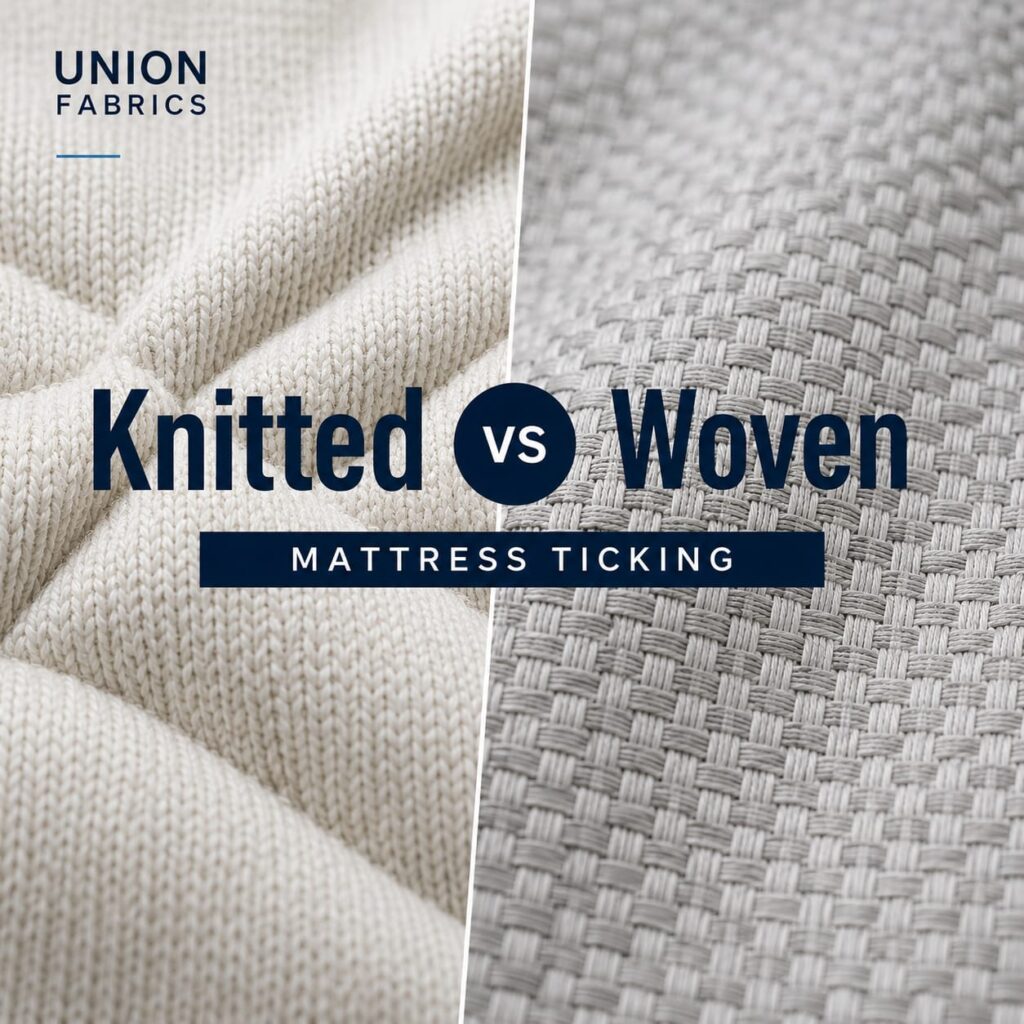
Woven mattress ticking generally outperforms knitted ticking on abrasion resistance and dimensional stability, making it the stronger choice for innerspring borders and structured panels. Knitted ticking offers more stretch and faster recovery after compression packing, making it better suited to hybrid mattress tops and bed-in-a-box constructions. Most hybrid mattress brands use both, matching each construction to the part of the mattress it covers rather than picking one for the entire product.
A hybrid mattress combines an innerspring support core with a foam or latex comfort layer, which means the ticking covering it has to perform two different jobs depending on where it sits. The panel over the springs needs to hold its shape under repeated point pressure. The top covering the foam layer needs to stretch and contour without resisting the body. This is why the knit versus woven question rarely has a single right answer, and why understanding what each construction actually does mechanically matters more than picking a side.
How the two constructions are built, and why it changes performance
Woven ticking is made by interlacing two sets of yarn, warp and weft, at right angles. This interlacing is what gives woven fabric its dimensional stability. The yarns lock against each other, so the fabric resists stretching out of shape under load, which is exactly what a mattress border needs when it is bearing weight at the edge of the bed night after night.
Knitted ticking, including the circular knit fabrics widely used for mattress panels, is built from interlocking loops rather than crossed yarns. That loop structure is inherently more elastic. It is also why knitted fabric drapes and contours differently. The same property that makes it comfortable over a foam layer is the property that makes it less suited to a structural border.
Durability: where woven ticking has the clearer edge
Abrasion resistance is typically measured using Martindale testing, which counts how many rubbing cycles a fabric withstands before visible wear appears. Tightly woven ticking constructions commonly reach Martindale ratings in the tens of thousands of cycles, which is part of why woven damask has remained the standard choice for mattress borders and structured panels for decades. Knitted fabrics generally test lower on the same scale, not because the yarn itself is weaker, but because the loop structure allows more localized movement under friction.
This does not make knitted ticking a lesser fabric. It makes it a different tool. A mattress panel that needs to stretch over a foam comfort layer is not subjected to the same sustained edge pressure as a border, so the lower abrasion number matters less in that location than the stretch and recovery properties knitted fabric provides instead.
Stretch, contour, and why this matters more on hybrids than traditional innersprings
Knitted fabric typically elongates significantly more than woven fabric before reaching its limit, which is what allows it to follow the contour of a foam or latex layer without puckering or creating pressure points the sleeper can feel through the cover. On a hybrid mattress, where the comfort layer is doing most of the work a sleeper actually feels, a ticking that resists this movement can undercut the comfort layer’s own performance, regardless of how good the foam underneath is.
This is also why product development teams increasingly specify knitted ticking for the top panel of a hybrid mattress even when the borders and base remain woven. The fabric is being matched to the mechanical demand of each zone rather than treated as a single, uniform spec across the whole product.
Roll-packing and recovery for mattress-in-a-box production
Hybrid mattresses sold direct-to-consumer are frequently compressed and roll-packed for shipping, which puts a different kind of stress on ticking than a traditional retail mattress ever experiences. Fabric needs to recover its shape quickly once the mattress is unboxed, without visible creasing or a flattened, stressed appearance at the seams.
Knitted constructions tend to recover from compression more readily than tightly woven ones, because the same loop elasticity that helps the fabric contour a foam layer also helps it spring back after being rolled under vacuum for days or weeks in transit. Brands building a bed-in-a-box hybrid product often lean toward knit for this reason alone, even when durability considerations might otherwise favor a woven border.
Breathability and how construction affects airflow
Open-knit structures generally allow more air to move through the fabric than a tightly woven construction of similar weight, which is one reason knitted panels are common on mattresses marketed around temperature regulation. A densely woven damask, by contrast, traps more air near the sleep surface, which can work against a brand’s cooling claims if the ticking is not chosen with that tradeoff in mind.
This is a case where the fabric choice has to align with the marketing claim being made on the box. A brand promising a cooling hybrid mattress while specifying a tight, heavy woven panel on top is working against its own product story at the fabric level, before the foam or any cooling additive even comes into play.
Custom design and minimum order quantities
Woven jacquard remains the easier construction for precise geometric patterns, logos, or brand-specific designs, since the pattern is built directly into the interlacing of the yarns during weaving. Knitted jacquard can replicate some of this, but tends to suit softer, less geometrically sharp designs better than fine line work or text.
MOQ also tends to differ between the two. Knitted ticking commonly allows smaller minimum order quantities than custom woven jacquard, which carries higher setup costs tied to loom configuration. Brands piloting a new hybrid mattress line in smaller initial volumes sometimes find this MOQ difference shapes the construction decision as much as the performance characteristics do.
How most hybrid mattress brands actually decide
In practice, the choice is rarely either-or. A typical hybrid mattress uses woven ticking for the base and side panels, where dimensional stability under repeated load matters most, and knitted ticking for the top panel, where stretch, contour, and breathability over the comfort layer matter more. The decision is made zone by zone, based on what each part of the mattress is mechanically asked to do, rather than as a single fabric choice applied across the entire product.
For a product development team specifying fabric for a new hybrid line, the more useful question is rarely which construction is better in the abstract. It is which construction is right for this specific panel, given what sits beneath it and how the finished mattress will be packed and shipped.
If you are specifying fabric for a new hybrid mattress line, we can put together a side-by-side swatch set of knit and woven ticking constructions so your team can compare hand feel, stretch, and recovery directly before committing to a panel-by-panel spec.
Frequently Asked Questions
Is knitted or woven mattress ticking better for hybrid mattresses?
Neither is universally better. Woven ticking is generally stronger for borders and structured panels, while knitted ticking suits the top panel over a foam or latex comfort layer because it stretches and contours more readily. Most hybrid mattresses use both, matched to each panel’s function.
Which mattress ticking construction is more durable?
Woven ticking typically tests higher on Martindale abrasion resistance than knitted ticking, due to the locked interlacing of warp and weft yarns, making it the stronger choice for high-friction areas like mattress borders.
Why do bed-in-a-box mattresses often use knitted ticking?
Knitted fabric generally recovers its shape faster after compression and roll-packing than woven fabric, which makes it better suited to mattresses that are vacuum-packed for shipping and need to look fully recovered once unboxed.
Does mattress ticking construction affect how cool or warm a mattress sleeps?
Yes. Open-knit constructions generally allow more airflow than tightly woven fabric of similar weight, which is why knitted panels are common on mattresses marketed for temperature regulation.
Can woven and knitted ticking be used on the same mattress?
Yes, and this is standard practice on hybrid mattresses. Brands commonly specify woven ticking for the base and borders and knitted ticking for the top panel, matching each construction to the mechanical demands of that zone.