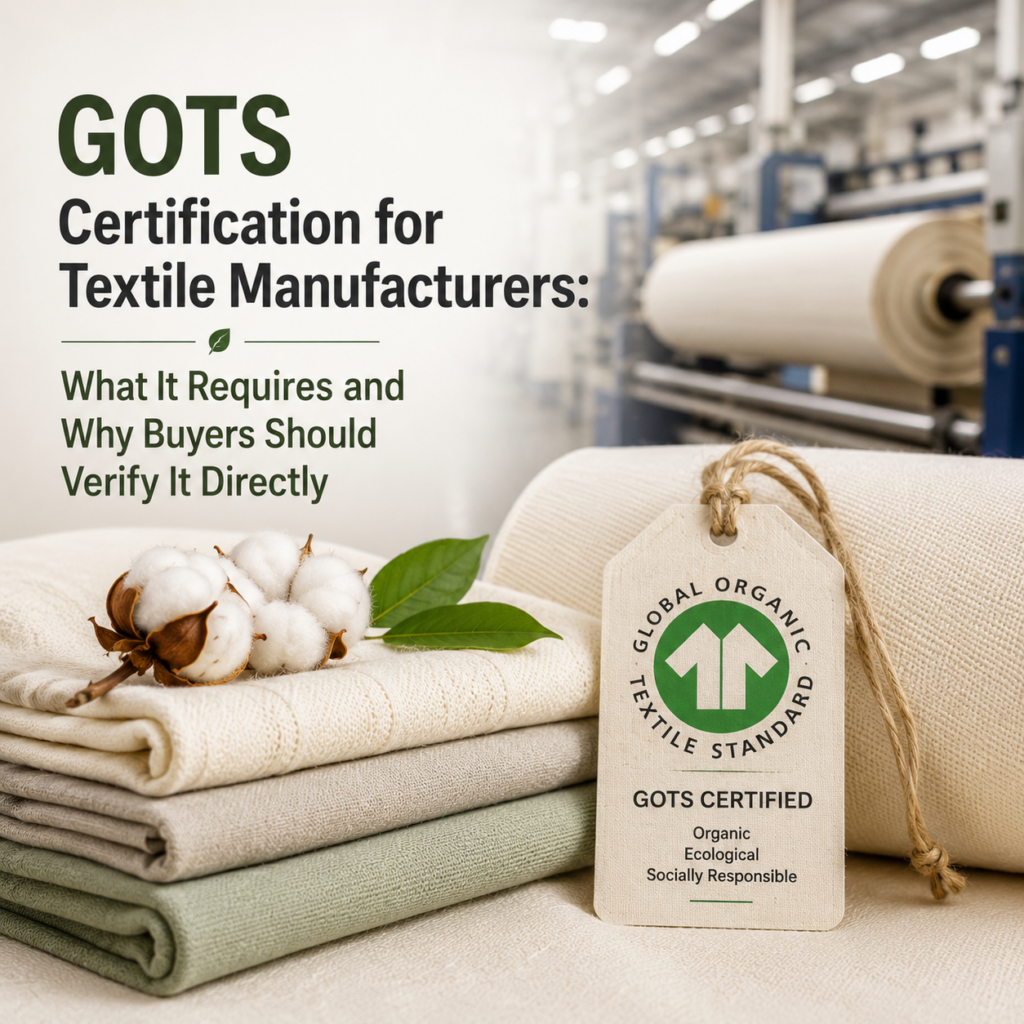
GOTS certification requires that a textile manufacturer’s organic fibre content, processing chemistry, and labour practices are independently audited across the entire supply chain, not just verified at the farm level. Buyers should verify GOTS status directly by searching the manufacturer’s license number in the GOTS public database and requesting a copy of their Scope Certificate, rather than relying on a logo or a general claim of certification, since neither a logo nor a verbal claim is independently checkable.
A GOTS logo on a supplier’s website or sample tag is not proof of anything by itself. It is a claim, and like any claim in B2B sourcing, it is worth exactly as much as a buyer’s ability to independently confirm it. This matters more for GOTS specifically than for most certifications, because the organic textile market has grown fast enough that certification claims have outpaced the number of buyers who actually check them, and the gap between the two is where unverified or expired claims tend to surface.
What GOTS certification actually covers
GOTS, the Global Organic Textile Standard, sets criteria across two broad categories: the organic content of the fibre itself, and the environmental and social conditions under which that fibre is processed into finished fabric. A textile labelled organic under GOTS must contain a minimum of 95 percent certified organic fibre, while a lower label tier, made with organic materials, permits a minimum of 70 percent. These are distinct claims, and a manufacturer’s certification should specify which tier applies to which products, not just state that the facility is GOTS certified in general terms.
On the processing side, GOTS restricts the chemicals permitted during dyeing, bleaching, and finishing, and requires environmental management practices around wastewater and chemical handling. It also incorporates social criteria covering labour conditions, drawn from International Labour Organization standards, which is a dimension of GOTS that buyers focused purely on the organic fibre question sometimes overlook.
Scope Certificates and Transaction Certificates are not the same document
This is the distinction that separates a buyer doing genuine diligence from one accepting a claim at face value. A Scope Certificate confirms that a manufacturing facility is certified to operate according to GOTS criteria for a defined list of product categories and processing steps. It is issued once and renewed annually, and it is the same document shown to every client, regardless of which specific order is being discussed.
A Transaction Certificate is different. It confirms that a specific shipment, tied to a specific order, was produced under GOTS-compliant conditions by entities that hold valid certification at every stage of that particular supply chain. Many buyers only ever request the Scope Certificate, because it is easier for a supplier to provide and looks satisfying on file. A buyer who wants assurance that a specific production run was genuinely GOTS compliant, not just that the facility is generally certified, should ask for the Transaction Certificate tied to that order.
How to actually verify a license number
GOTS maintains a public database specifically for this purpose, searchable by company name, country, or license number. Entering a supplier’s license number should return their certified entity profile, showing their certification status, the certifying body that issued it, and the scope of products and processes covered. If a search returns nothing, that is a legitimate reason to ask the supplier directly for an explanation, since a properly licensed entity should appear in the database.
GOTS itself is explicit that the database entry is not, by itself, definitive proof of current certified status. The database is a starting point. The actual proof is the Scope Certificate document, which should be requested directly from the supplier and should show the supplier’s details, the certifying body’s name, the specific scope of certification, and the period of validity. If there is any doubt about a certificate’s authenticity, the certifying body that issued it can be contacted directly using the certificate number to confirm it is genuine.
Why this verification step gets skipped, and why that is a mistake
Verification gets skipped most often not because buyers do not care, but because a supplier relationship is already underway and asking feels like it implies distrust. In practice, the opposite is true. A legitimate, properly certified manufacturer expects this question and can answer it immediately, because providing the Scope Certificate and license number is a routine part of working with GOTS-conscious buyers. Hesitation or vague reassurance in response to a direct request for documentation is itself useful information.
The cost of skipping this step is not evenly distributed. It is low in the vast majority of cases, where the supplier’s certification is genuine and current. It is high in the minority of cases where it is not, because a brand that has marketed a product as GOTS certified based on an unverified supplier claim is exposed to that failure becoming public, whether through a retailer’s own audit, a customer’s independent check, or a certifying body’s enforcement action.
What buyers should specifically ask for
A practical verification request has three parts. First, the supplier’s GOTS license number, which should be searchable in the public database. Second, a copy of the current Scope Certificate, showing the specific product categories and processing steps covered, since certification of one process does not automatically mean every product the supplier makes is covered. Third, for a specific large order, a Transaction Certificate tied to that shipment, particularly when the order is large enough that a failure of organic integrity would be commercially significant.
Asking for these three things is a normal, expected part of sourcing from a GOTS-certified manufacturer, not an unusual demand. A manufacturer that treats this request as routine, because it is asked regularly and has the documentation ready, is demonstrating exactly the kind of operational maturity that makes a certification claim trustworthy in the first place.
If you are evaluating us as a GOTS-certified supplier, we will provide our current license number and Scope Certificate directly, so you can verify our status in the public database before placing an order rather than taking our word for it.
Frequently Asked Questions
How do I check if a textile manufacturer’s GOTS certification is real?
Search the manufacturer’s license number in the GOTS public database on the official Global Organic Textile Standard website, and request a copy of their Scope Certificate directly, which shows the certifying body, the scope of products covered, and the certification’s validity period.
What is the difference between a GOTS Scope Certificate and a Transaction Certificate?
A Scope Certificate confirms a facility is certified to GOTS standards generally, for a defined list of products and processes, and is the same document shown to every buyer. A Transaction Certificate confirms that a specific shipment was produced under GOTS-compliant conditions across every entity in that order’s supply chain.
Is the GOTS public database enough to verify a supplier’s certification?
The database is a useful starting point but is not, on its own, definitive proof of current certified status according to GOTS’s own guidance. Buyers should also request the supplier’s actual Scope Certificate and, if in doubt, confirm authenticity directly with the certifying body listed on it.
What percentage of organic fibre does GOTS certification require?
Products labelled organic under GOTS must contain at least 95 percent certified organic fibre. A lower tier, labelled made with organic materials, permits a minimum of 70 percent organic fibre content.
Does GOTS certification cover anything beyond organic fibre content?
Yes. GOTS also restricts processing chemicals used in dyeing and finishing, sets environmental management requirements, and includes social criteria covering labour conditions across the certified supply chain, not just the organic status of the raw fibre.