Thread count is a poor standalone measure of bedding quality because it can be inflated by counting multi-ply yarns as separate threads, and because fiber staple length, yarn quality, and weave type affect softness and durability more than the raw number. A physically honest single-ply thread count tops out around 500 to 600 per square inch, which means any figure advertised well above that is almost always achieved through multi-ply construction rather than a genuinely denser weave. Thread count is one of the most specified numbers on a bedding tech pack, and one of the most poorly understood, including by brand-side teams who specify it confidently without fully grasping what the number does and does not tell them. This matters more for a buyer writing a specification than for a consumer reading a label, because a buyer who specifies the wrong thing ends up paying for a number rather than the quality outcome they actually wanted. What thread count actually measures Thread count is the number of horizontal and vertical threads woven into one square inch of fabric, combining the warp threads running lengthwise and the weft threads running crosswise. A fabric with 200 warp threads and 200 weft threads in that square inch has a thread count of 400. This is a real, measurable property of the weave's density, and it is not meaningless. The problem is what happens once the number becomes a marketing lever rather than a manufacturing specification. The multi-ply problem, and why it matters for sourcing It is physically difficult to weave more than roughly 500 to 600 genuine single-ply threads into one square inch of fabric using standard cotton yarn. Numbers advertised well above that range, the 800, 1000, or 1500 thread count claims that show up in retail marketing, are almost always achieved by twisting two or more thinner, often lower-quality, strands together into a single yarn and counting each strand separately in the final figure. This is not a meaningless technicality for a brand buyer. A fabric built from multi-ply yarn to hit a high advertised thread count can end up heavier, less breathable, and less durable than an honestly constructed single-ply fabric at a much lower count, because the underlying strands are frequently thinner and weaker to begin with. A buyer specifying thread count without specifying ply construction has left open exactly the loophole that produces this outcome, and a mill filling that specification without further direction may default to whichever construction is cheapest to produce, not necessarily the one that delivers the hand feel the brand actually wants. What actually determines how a sheet feels and lasts Fiber staple length is the single factor most experienced product developers point to first. Long-staple and extra-long-staple cotton, the categories that include Egyptian and Pima cotton, produce smoother, stronger yarn than standard short-staple cotton, because longer fibers create fewer loose fiber ends within the spun yarn. Fewer loose ends means less friction, less pilling over repeated washing, and a noticeably smoother hand feel, independent of whatever the thread count label says. Weave type changes the experience as much as fiber quality does, and in a different direction depending on what a brand is trying to achieve. Percale, a simple one-over-one-under weave, produces a crisp, matte, breathable fabric typically specified in a lower thread count range than sateen, since percale's structure does not benefit from higher density the way sateen's does. Sateen uses a four-over-one-under structure that puts more thread surface facing up, producing the smooth, lustrous feel associated with higher-end sheets, typically at a higher thread count than percale for a comparable price tier. Specifying a single ideal thread count across both weave types misunderstands how the two structures actually work. Why a brand might still specify thread count, used correctly None of this means thread count should be dropped from a spec sheet entirely. Used alongside fiber type, staple length, and ply, it remains a legitimate and useful density measure, particularly for comparing two fabrics of the same weave and fiber type against each other. The mistake is treating thread count as a standalone quality signal that can be compared meaningfully across different fiber types, weaves, and ply constructions, which is exactly the comparison most retail marketing invites a consumer, and sometimes a less experienced buyer, to make. A useful range for most general-purpose retail bedding sits between roughly 200 and 600, depending on weave type, with figures well above that range warranting a direct question to the mill about ply construction before the number is taken at face value. A buyer who asks specifically whether a quoted thread count reflects single-ply or multi-ply yarn is asking the one question that actually disambiguates an inflated number from a genuinely dense weave. What this means for writing a tech pack A specification that lists thread count alone is incomplete. A more useful tech pack specifies fiber type and staple length, ply construction, weave type, and thread count together, since each of these interacts with the others to produce the finished fabric's actual performance. Two sheets at an identical thread count can feel meaningfully different once fiber quality and ply are accounted for, which is precisely why specifying thread count in isolation leaves too much of the outcome undefined. This also gives a brand buyer a sharper set of questions to bring into a supplier conversation. Instead of negotiating purely on thread count, a buyer who understands what actually drives quality can ask a mill directly about staple length, ply, and weave construction, and judge a quoted price against those factors rather than against a number that, on its own, says less than it appears to. If you are building out a bedding line and want help specifying fiber, ply, and weave correctly rather than defaulting to thread count alone, we can walk your team through sample constructions at different quality tiers before you finalize a tech pack. Frequently Asked Questions What is a good thread count for bedding? Most quality bedding falls in the 200 to 600 range, depending on weave type. Figures advertised well above 800 are typically achieved through multi-ply yarn construction rather than a genuinely denser single-ply weave, and should prompt a direct question about ply before being treated as a meaningful quality signal. Does higher thread count always mean better quality sheets? No. Thread count measures weave density, not overall quality. Fiber staple length, yarn ply, and weave type affect softness, breathability, and durability as much as or more than the raw thread count number. What is the difference between single-ply and multi-ply thread count? Single-ply yarn uses one continuous strand per thread, while multi-ply yarn twists two or more thinner strands together. Some manufacturers count each strand in a multi-ply yarn separately, inflating the advertised thread count without actually increasing fabric density or quality. Why do percale and sateen sheets have different ideal thread counts? Percale uses a simple one-over-one-under weave that is typically specified at a lower thread count for a crisp, breathable feel. Sateen uses a denser four-over-one-under structure that supports a higher thread count, producing a smoother, more lustrous finish. What should a tech pack specify instead of thread count alone? A complete specification should include fiber type and staple length, yarn ply, weave type, and thread count together, since these factors interact to determine the finished fabric's actual hand feel and durability.

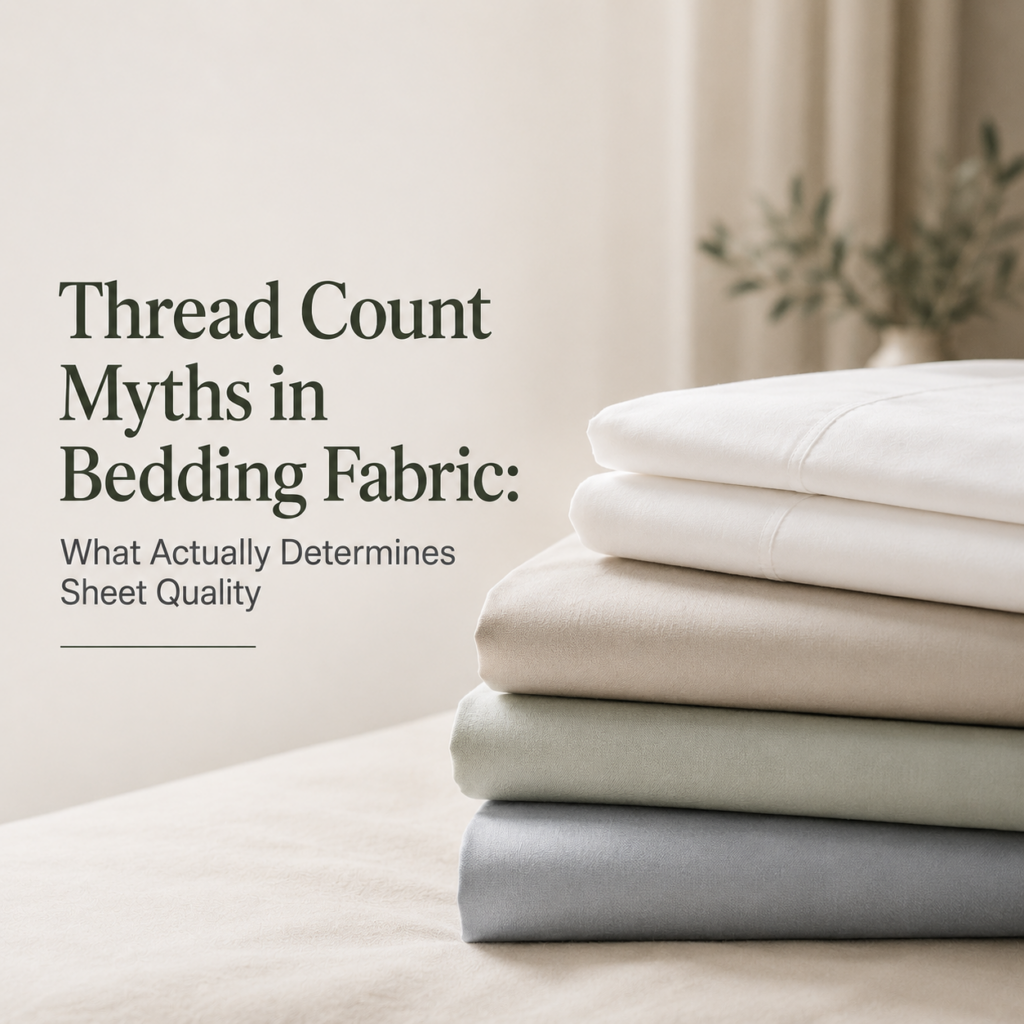
Thread Count Myths in Bedding Fabric: What Actually Determines Sheet Quality

Thread count is a poor standalone measure of bedding quality because it can be inflated by counting multi-ply yarns as […]

Thread count is a poor standalone measure of bedding quality because it can be inflated by counting multi-ply yarns as separate threads, and because fiber staple length, yarn quality, and weave type affect softness and durability more than the raw number. A physically honest single-ply thread count tops out around 500 to 600 per square inch, which means any figure advertised well above that is almost always achieved through multi-ply construction rather than a genuinely denser weave.

Thread count is one of the most specified numbers on a bedding tech pack, and one of the most poorly understood, including by brand-side teams who specify it confidently without fully grasping what the number does and does not tell them. This matters more for a buyer writing a specification than for a consumer reading a label, because a buyer who specifies the wrong thing ends up paying for a number rather than the quality outcome they actually wanted.

What thread count actually measures

Thread count is the number of horizontal and vertical threads woven into one square inch of fabric, combining the warp threads running lengthwise and the weft threads running crosswise. A fabric with 200 warp threads and 200 weft threads in that square inch has a thread count of 400. This is a real, measurable property of the weave’s density, and it is not meaningless. The problem is what happens once the number becomes a marketing lever rather than a manufacturing specification.

The multi-ply problem, and why it matters for sourcing

It is physically difficult to weave more than roughly 500 to 600 genuine single-ply threads into one square inch of fabric using standard cotton yarn. Numbers advertised well above that range, the 800, 1000, or 1500 thread count claims that show up in retail marketing, are almost always achieved by twisting two or more thinner, often lower-quality, strands together into a single yarn and counting each strand separately in the final figure.

This is not a meaningless technicality for a brand buyer. A fabric built from multi-ply yarn to hit a high advertised thread count can end up heavier, less breathable, and less durable than an honestly constructed single-ply fabric at a much lower count, because the underlying strands are frequently thinner and weaker to begin with. A buyer specifying thread count without specifying ply construction has left open exactly the loophole that produces this outcome, and a mill filling that specification without further direction may default to whichever construction is cheapest to produce, not necessarily the one that delivers the hand feel the brand actually wants.

What actually determines how a sheet feels and lasts

Fiber staple length is the single factor most experienced product developers point to first. Long-staple and extra-long-staple cotton, the categories that include Egyptian and Pima cotton, produce smoother, stronger yarn than standard short-staple cotton, because longer fibers create fewer loose fiber ends within the spun yarn. Fewer loose ends means less friction, less pilling over repeated washing, and a noticeably smoother hand feel, independent of whatever the thread count label says.

Weave type changes the experience as much as fiber quality does, and in a different direction depending on what a brand is trying to achieve. Percale, a simple one-over-one-under weave, produces a crisp, matte, breathable fabric typically specified in a lower thread count range than sateen, since percale’s structure does not benefit from higher density the way sateen’s does. Sateen uses a four-over-one-under structure that puts more thread surface facing up, producing the smooth, lustrous feel associated with higher-end sheets, typically at a higher thread count than percale for a comparable price tier. Specifying a single ideal thread count across both weave types misunderstands how the two structures actually work.

Why a brand might still specify thread count, used correctly

None of this means thread count should be dropped from a spec sheet entirely. Used alongside fiber type, staple length, and ply, it remains a legitimate and useful density measure, particularly for comparing two fabrics of the same weave and fiber type against each other. The mistake is treating thread count as a standalone quality signal that can be compared meaningfully across different fiber types, weaves, and ply constructions, which is exactly the comparison most retail marketing invites a consumer, and sometimes a less experienced buyer, to make.

A useful range for most general-purpose retail bedding sits between roughly 200 and 600, depending on weave type, with figures well above that range warranting a direct question to the mill about ply construction before the number is taken at face value. A buyer who asks specifically whether a quoted thread count reflects single-ply or multi-ply yarn is asking the one question that actually disambiguates an inflated number from a genuinely dense weave.

What this means for writing a tech pack

A specification that lists thread count alone is incomplete. A more useful tech pack specifies fiber type and staple length, ply construction, weave type, and thread count together, since each of these interacts with the others to produce the finished fabric’s actual performance. Two sheets at an identical thread count can feel meaningfully different once fiber quality and ply are accounted for, which is precisely why specifying thread count in isolation leaves too much of the outcome undefined.

This also gives a brand buyer a sharper set of questions to bring into a supplier conversation. Instead of negotiating purely on thread count, a buyer who understands what actually drives quality can ask a mill directly about staple length, ply, and weave construction, and judge a quoted price against those factors rather than against a number that, on its own, says less than it appears to.

If you are building out a bedding line and want help specifying fiber, ply, and weave correctly rather than defaulting to thread count alone, we can walk your team through sample constructions at different quality tiers before you finalize a tech pack.

Frequently Asked Questions

What is a good thread count for bedding?

Most quality bedding falls in the 200 to 600 range, depending on weave type. Figures advertised well above 800 are typically achieved through multi-ply yarn construction rather than a genuinely denser single-ply weave, and should prompt a direct question about ply before being treated as a meaningful quality signal.

Does higher thread count always mean better quality sheets?

No. Thread count measures weave density, not overall quality. Fiber staple length, yarn ply, and weave type affect softness, breathability, and durability as much as or more than the raw thread count number.

What is the difference between single-ply and multi-ply thread count?

Single-ply yarn uses one continuous strand per thread, while multi-ply yarn twists two or more thinner strands together. Some manufacturers count each strand in a multi-ply yarn separately, inflating the advertised thread count without actually increasing fabric density or quality.

Why do percale and sateen sheets have different ideal thread counts?

Percale uses a simple one-over-one-under weave that is typically specified at a lower thread count for a crisp, breathable feel. Sateen uses a denser four-over-one-under structure that supports a higher thread count, producing a smoother, more lustrous finish.

What should a tech pack specify instead of thread count alone?

A complete specification should include fiber type and staple length, yarn ply, weave type, and thread count together, since these factors interact to determine the finished fabric’s actual hand feel and durability.
Leave a Comment

Your email address will not be published. Required fields are marked *

Scroll to Top