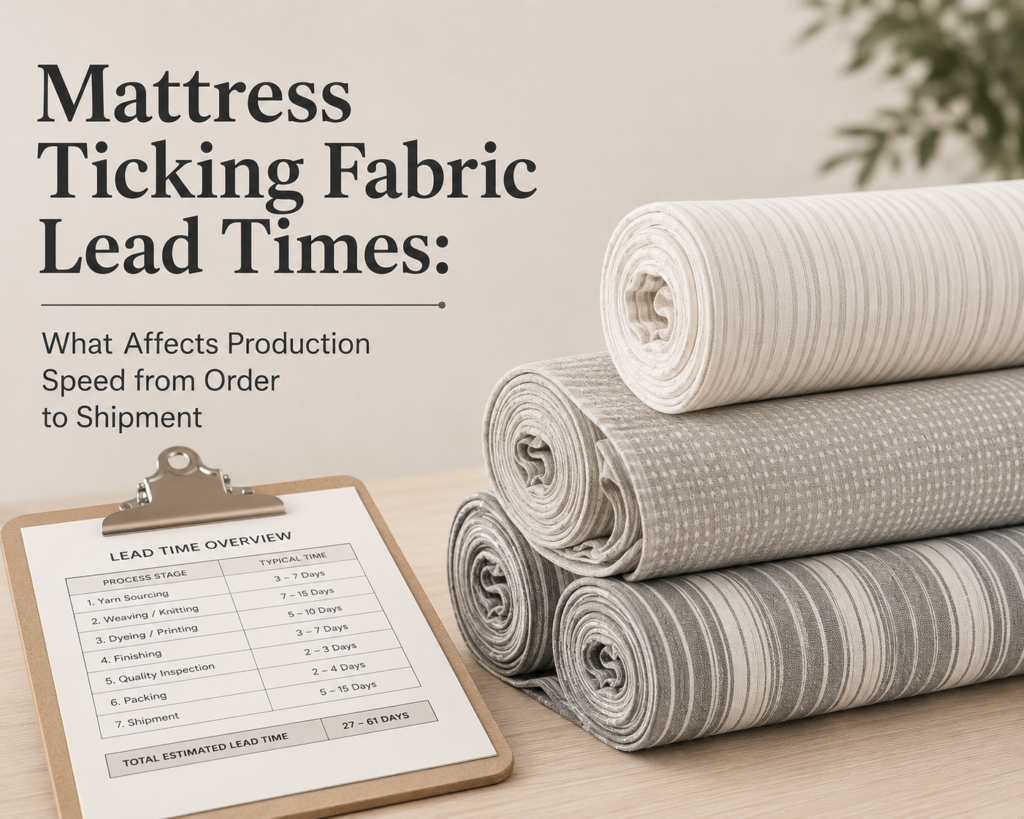
Mattress ticking fabric lead time, typically 75 to 105 days FOB for a vertically integrated mill, is shaped mainly by dyeing and finishing capacity availability, construction complexity, and whether the order falls during a seasonal demand peak when multiple clients compete for the same production slots. Sample approval timing also affects the start date, since bulk production scheduling generally does not begin until a buyer signs off on the sample. Buyers who ask what specifically a quoted lead time includes get a more reliable planning number than buyers who accept a single headline figure.
A quoted lead time is one number standing in for a sequence of distinct production stages, each with its own potential to run faster or slower than planned. A buyer who understands what is actually inside that number is in a much better position to plan a launch calendar realistically, and to know which questions to ask a mill before committing to a date that depends on it.
What a lead time quote actually covers
A fabric lead time generally spans from order confirmation through to the goods being ready for shipment, FOB the originating port, and typically includes weaving or knitting the base fabric, dyeing and finishing, any specialized processing like lamination, and final quality inspection before the order is released. It does not typically include the ocean freight transit time to the buyer’s destination port, which adds several additional weeks depending on origin and destination, nor does it usually include the sample approval period that precedes the start of bulk production.
This is worth clarifying explicitly with any supplier, since two mills quoting what sounds like a similar lead time can mean different things by it if one is counting from order confirmation and the other is counting from sample approval, a distinction that can represent several weeks of difference in a buyer’s actual calendar.
Why dyeing capacity is often the real constraint
Weaving capacity is rarely the bottleneck in a vertically integrated mill running hundreds of looms. Dyeing and finishing capacity is a tighter constraint, since these stages run on a smaller number of lines that have to be shared across every client’s orders moving through the mill at the same time. A buyer’s order entering the schedule when dyeing capacity is already heavily booked by other clients will wait longer for an available slot than the same order would during a quieter period, independent of how quickly the weaving stage itself could be completed.
This is why a mill’s honest answer to a lead time question should include something about current capacity utilization, not just a flat number that ignores whether the specific window a buyer needs happens to be a busy one.
How seasonal demand changes the picture
Textile production, like most manufacturing, experiences predictable seasonal peaks tied to major retail buying cycles, and demand from multiple clients converging on the same production window during these peaks is one of the most common reasons a normally reliable lead time stretches longer than quoted. A buyer planning a launch around a peak season retail window should build in additional schedule buffer specifically because that timing puts them in competition with other clients’ orders for the same finite dyeing and finishing capacity.
Asking a mill directly whether a target shipping window falls during a typically busy period, and what buffer they would recommend as a result, gets a more useful answer than asking only for the standard lead time figure in isolation.
How construction complexity changes lead time
A standard construction already running regularly through a mill’s production schedule moves through weaving, dyeing, and finishing with minimal additional setup. A custom jacquard pattern or a fabric requiring multiple specialized processing steps, such as lamination after standard finishing, adds discrete setup time at each additional stage, which compounds across a longer overall production sequence than a simpler construction would require.
This is part of why a single lead time figure quoted for an entire product category can be misleading. The realistic answer depends on the specific construction, not just the general type of fabric, which is why a detailed quote tied to an actual specification is more useful to a buyer building a launch calendar than a general published range.
Why sample approval timing matters more than buyers expect
Bulk production scheduling generally does not begin until a buyer has approved the sample, which means delays in a buyer’s own internal sample review and approval process push back the bulk lead time clock just as much as a delay on the mill’s side would. A buyer who takes three weeks to circulate a sample internally for sign-off has effectively added three weeks to their own launch timeline, independent of anything the mill controls.
Buyers planning around a fixed launch date should treat fast internal sample turnaround as something within their own control that directly protects the overall schedule, rather than assuming the lead time clock only depends on the mill’s performance.
What a realistic lead time conversation looks like
A buyer asking a mill for a lead time should expect, and should ask for, more than a single number. A useful answer specifies what the quoted window includes, what current capacity utilization looks like for the relevant production stage, whether the target shipping window falls during a seasonal peak, and what happens if any single stage runs into a delay. A mill able to answer all of this specifically, rather than repeating a marketing figure, is demonstrating the kind of production transparency that predicts whether the quoted date will actually hold.
If you are planning a launch calendar around a specific shipping date, tell us your construction and target window and we will give you a realistic lead time estimate that accounts for current capacity, not just a standard published range.
Frequently Asked Questions
What is a typical lead time for mattress ticking fabric?
A common range for vertically integrated mills is 75 to 105 days FOB from order confirmation to goods ready for shipment, though this varies by construction complexity, current production capacity, and whether the order falls during a seasonal demand peak.
Does fabric lead time include ocean freight shipping time?
Typically not. A quoted lead time usually covers production through goods being ready FOB at the originating port. Ocean freight transit to the buyer’s destination adds several additional weeks depending on origin and destination.
Why do dyeing and finishing stages affect lead time more than weaving?
Weaving capacity is rarely the constraint in a large mill running many looms simultaneously. Dyeing and finishing run on fewer shared lines across all of a mill’s clients, making capacity availability at these stages the more common bottleneck affecting overall lead time.
Does sample approval time count toward the lead time clock?
Bulk production scheduling generally begins only after a buyer approves the sample, so delays in a buyer’s internal sample review process extend the overall timeline just as much as a delay on the mill’s side, even though this time is not always included in a quoted lead time figure.
Why does a custom construction take longer than a standard one?
Custom constructions, such as jacquard patterns or fabrics requiring additional processes like lamination, add discrete setup time at each stage. This compounds across the production sequence compared to a standard construction already running in regular production rotation.