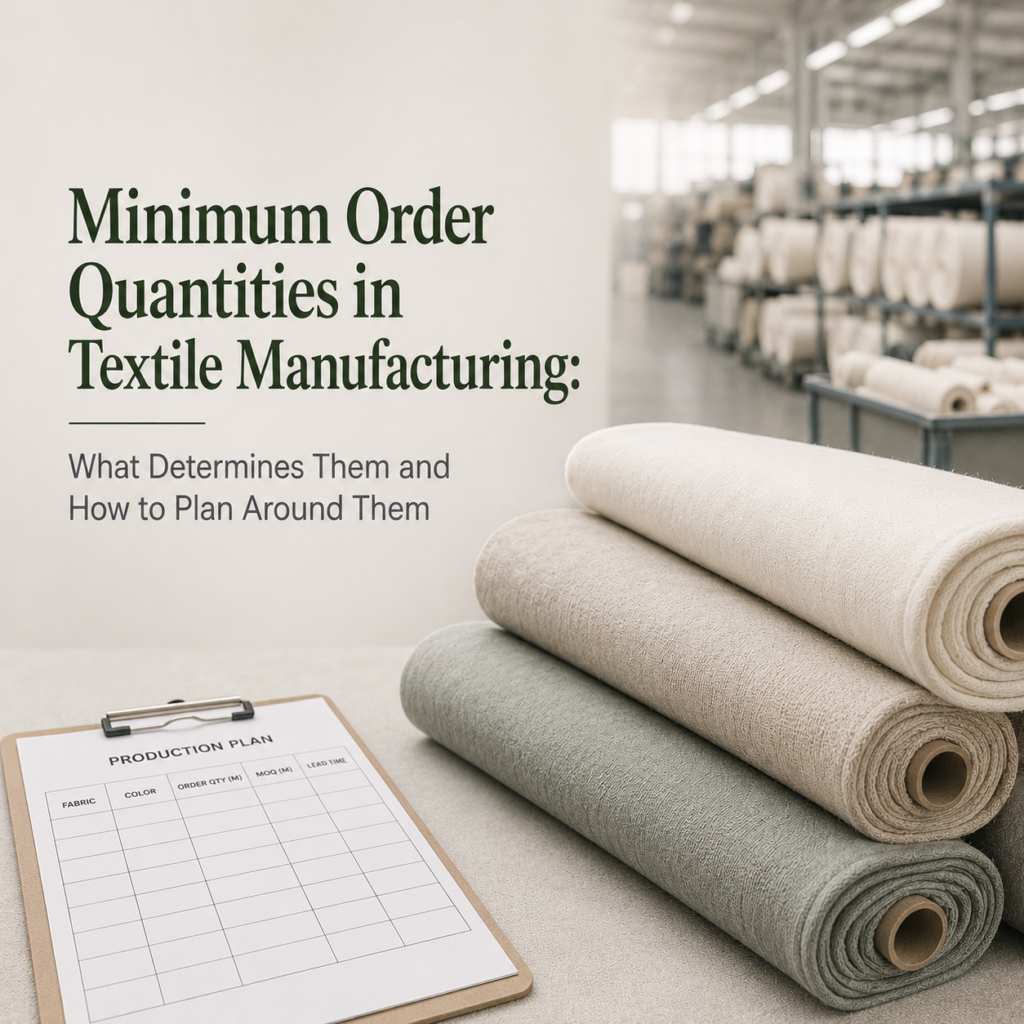
A textile mill’s minimum order quantity is driven mainly by how much fabric is needed to fill a production batch efficiently, typically tied to roll length, dye lot size, and loom changeover cost. Standard constructions usually carry a lower MOQ, often in the low thousands of metres, while custom jacquard, digital print, or specialty dyeing require a higher MOQ, sometimes several times higher, because setup and tooling costs need to be spread across enough volume to make the run economically viable for the mill.
MOQ is consistently one of the first three questions a buyer asks a new fabric supplier, and for good reason. It directly determines whether a brand can actually afford to test a new construction before committing serious budget, and a mismatch between a buyer’s expected order size and a mill’s MOQ wastes time for both sides if it surfaces late in a conversation rather than upfront.
Why MOQ exists at all
A fabric mill’s production runs in batches, not continuously per individual order. Dyeing equipment, finishing lines, and looms all have a minimum efficient batch size, below which the cost of running the machine, mixing a dye lot, or reconfiguring a loom for a specific construction outweighs what the buyer is paying for the fabric itself. A mill setting an MOQ is not arbitrarily gatekeeping smaller buyers. It is stating the point below which producing the order stops being economically viable for the mill to run at all.
This is also why MOQ is typically expressed as a quantity tied to a full or near-full production batch, whether that is a complete fabric roll, a dye vat’s minimum fill, or a loom’s most efficient run length, rather than as an arbitrary round number chosen for its own sake.
Why standard constructions carry a lower MOQ than custom work
A standard construction, one the mill already weaves regularly using existing loom settings, common dye recipes, and familiar finishing parameters, can be slotted into existing production scheduling without significant additional setup work. This is why standard constructions typically carry MOQs in the low thousands of metres, a volume threshold tied mainly to making efficient use of a production run rather than to any unusual setup cost.
Custom work changes this calculation substantially. A custom jacquard design requires the loom to be configured specifically for that pattern, work that has to be amortized across the order rather than absorbed into routine production. Digital printing carries its own setup considerations tied to color matching, design file preparation, and machine calibration for a pattern that has not been run before. This is the direct reason custom jacquard or digital print constructions typically require an MOQ several times higher than standard constructions, often in the range of 15,000 metres or more, since that additional setup cost needs enough volume behind it to make economic sense for the mill to take on.
How sample yardage fits into the MOQ conversation
Sample yardage is deliberately treated as a separate, much smaller request than a production MOQ, precisely so a buyer can evaluate a fabric’s hand feel, color, and construction before committing to bulk volume. A mill able to turn around sample yardage within roughly five to seven working days is signaling that its sampling process runs on a genuinely different, faster track than its bulk production scheduling, which matters enormously to a buyer trying to move quickly through an early evaluation phase before deciding whether to commit to a full MOQ order.
A buyer should not expect sample pricing or turnaround to predict bulk production timing. The two processes are intentionally decoupled, and a mill that conflates them, quoting bulk lead time for a sample request, may not have a mature sampling workflow separate from its production line.
How lead time and MOQ interact
Lead time and MOQ are related but distinct constraints, and buyers sometimes conflate them. A larger order does not necessarily take proportionally longer to produce once it clears the MOQ threshold, since the mill is already running an efficient batch size. What changes lead time more directly is whether dyeing capacity is immediately available, whether the order falls during a seasonal demand peak when multiple clients are competing for production slots, and how complex the specific construction is. A buyer planning a launch timeline should ask about lead time and MOQ as two separate questions, since a supplier’s answer to one does not reliably predict the other.
Practical ways buyers manage MOQ constraints
Several practical strategies help a buyer work within MOQ constraints without compromising on fabric choice. Choosing a standard construction already in a mill’s regular production rotation, rather than requesting a custom variation, is the single most direct way to access a lower MOQ. Combining multiple colorways or related styles under a shared base construction can sometimes let a buyer meet a combined volume threshold more easily than trying to hit the same MOQ on a single SKU alone.
For a brand testing a genuinely new, custom construction for the first time, treating the relationship as a staged commitment, starting with sample yardage, then a smaller pilot run if the mill can accommodate one, before scaling to a full MOQ order, reduces the financial risk of committing to bulk volume on an unproven design. Not every mill offers this flexibility for every construction, which is itself a useful question to ask early in a supplier conversation rather than assuming it is universally available.
If you are scoping a new product line and want to understand exactly where your construction falls between our standard and custom MOQ tiers, send us your spec and we will quote MOQ, sample timing, and lead time together so you can budget accurately before committing.
Frequently Asked Questions
What is a typical MOQ for mattress ticking or fabric orders?
Standard constructions typically carry an MOQ in the range of 3,000 metres, while custom jacquard or digital print constructions often require 15,000 metres or more, since custom work involves setup and tooling costs that need to be spread across a larger volume to remain economical for the mill.
Why do custom fabric designs have higher minimum order quantities?
Custom jacquard patterns and digital prints require loom configuration, color matching, and machine calibration specific to that design. These setup costs are fixed regardless of order size, so mills set a higher MOQ to ensure enough volume to make the setup economically worthwhile.
Does ordering fabric samples count toward the minimum order quantity?
No. Sample yardage is a separate, much smaller request specifically intended to let a buyer evaluate a fabric before committing to bulk production volume. Sample turnaround and pricing operate on a different track than the production MOQ.
Can a buyer negotiate a lower MOQ with a fabric mill?
Sometimes, particularly by choosing a standard construction already in regular production rather than a custom one, or by combining multiple colorways or related styles under a shared base construction to meet a combined volume threshold.
Does a larger order always take longer to produce than a smaller one?
Not necessarily once an order clears the mill’s efficient batch size. Lead time depends more on dyeing capacity availability, seasonal demand, and construction complexity than on order volume alone, which is why MOQ and lead time should be asked about as separate questions.