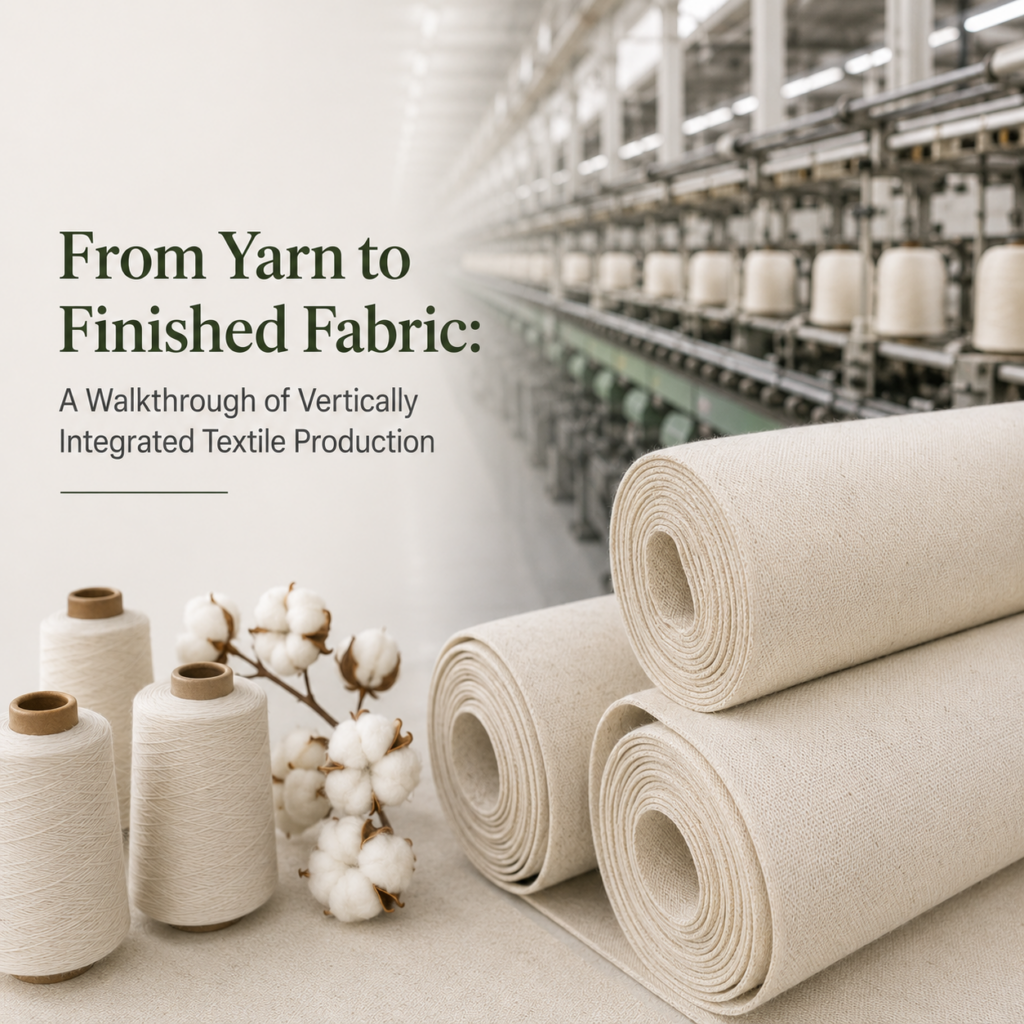
Vertically integrated textile production takes yarn through weaving or circular knitting, wet processing, finishing, and in some cases lamination or indigo dyeing, before a final stitching stage produces a finished product, all under one company’s quality control rather than being split across separate subcontracted facilities. Understanding each stage helps buyers ask sharper sourcing questions, since a mill’s actual capability at each step, not just its finished fabric samples, determines whether it can reliably deliver at the volume and consistency a brand needs.
Buyers newer to textile sourcing often use the phrase vertically integrated without a clear picture of what is actually happening on the factory floor when a supplier makes that claim. It is worth walking through the real stages, because each one represents a place where quality, consistency, or timeline can break down if a mill does not genuinely control it. This is also where a brand can ask sharper, more specific questions of a potential supplier than a generic capability conversation usually produces.
Stage one: weaving or knitting turns yarn into a flat structure
Yarn arrives at a weaving facility ready to be interlaced into fabric. In woven construction, warp yarns are stretched lengthwise across a loom while weft yarns are inserted crosswise, with air-jet looms being the dominant modern technology for this stage, capable of working across a wide range of constructions including plain weave, satin, twill, and more complex jacquard patterns where a dedicated jacquard weaving unit can build figured designs directly into the structure of the fabric. A facility running this stage at meaningful scale typically operates several hundred looms simultaneously, producing in the range of ten million metres or more per month across the full range of constructions a mill offers.
Circular knitting follows a different mechanical principle, looping yarn rather than interlacing it, using machines that produce continuous tubular fabric. This stage is particularly relevant for mattress ticking, where circular knit jacquard capability allows complex pattern and texture development with the stretch properties woven fabric cannot replicate. Knitting machinery suited to this work can typically handle tubular rolls up to around 100 kilograms, with both tubular and open-width output depending on the end product.
Stage two: wet processing prepares and colors the fabric
Fabric coming off a loom or knitting machine, known as greige fabric, is not yet ready for finishing or sale. Wet processing covers bleaching, dyeing, and printing, and at scale typically runs through a sequence of continuous bleaching ranges, dyeing stenters, and finishing stenters, often with several of each operating in parallel to handle production volume. A mill investing in this stage in-house, rather than subcontracting it to a separate dye house, removes one of the most common points where color consistency problems and schedule delays originate in less integrated supply chains.
Dyeing methods vary by what the fabric requires. Thermosol, pad batch, and pad steam dyeing methods each suit different fiber types and color requirements, and a mill offering multiple methods in-house has more flexibility to match the right process to a specific order rather than forcing every order through whichever single method it has access to. Modern wet processing facilities increasingly pair this stage with closed-loop water treatment, since wet processing is one of the more resource-intensive stages in the entire production chain.
Stage three: finishing shapes the fabric’s final hand feel and stability
Finishing is where a fabric gets its actual surface character and dimensional stability before it reaches a buyer. Emerizing creates a peach-skin or suede-like surface texture through controlled mechanical abrasion. Sanforizing pre-shrinks the fabric under controlled tension and moisture to guarantee dimensional stability, typically bringing residual shrinkage down to a small fraction of a percent, which matters enormously to a brand that cannot afford a product that shrinks unpredictably after the first wash. Calendering applies heat and pressure through rollers to produce a smooth, lustrous finish across woven constructions including sheeting, twill, satin, and drill.
This stage is easy to underestimate from outside a mill, because it does not change the fabric’s basic construction, but it determines almost everything a buyer or end customer actually feels and experiences when they touch the finished product.
Stage four, where applicable: specialized dyeing and lamination
Certain product categories require additional specialized stages beyond standard wet processing and finishing. Indigo dyeing for denim, for instance, typically uses a dedicated slasher line combining rope dyeing with simultaneous sizing in a single pass, a distinct process from the dyeing methods used on standard woven or knit fabric. Facilities running this stage increasingly power it with on-site renewable energy, since indigo dyeing is energy-intensive and represents a meaningful share of a denim-focused mill’s overall environmental footprint.
Lamination is another specialized stage, relevant to waterproof and functional fabrics like mattress protectors. This involves bonding woven, knitted, or non-woven substrates using hot-melt adhesives with films such as TPU, PVC, PE, or PTFE, producing the waterproof, windproof, or blackout properties those product categories require. In-house lamination capability is genuinely uncommon among textile mills generally, since it requires dedicated equipment and expertise distinct from standard weaving and dyeing operations, which is part of why brands sourcing functional fabrics specifically ask whether a potential supplier laminates in-house or subcontracts this step.
Stage five: stitching turns fabric into a finished product
The final stage converts finished fabric into the actual product a brand will sell, whether that is a mattress cover, a sheet set, or a garment. This stage runs on dedicated sewing lines, often several hundred machines in scale operations, producing finished pieces with custom hem treatments, embroidery placement, labelling, and packaging all completed in-house rather than handed off to a separate contract manufacturer.
Keeping this stage under the same roof and quality system as fabric production closes the loop on vertical integration in a way that matters specifically for consistency. A mill that weaves and dyes excellent fabric but subcontracts stitching to an outside facility has reintroduced exactly the kind of handoff point that vertical integration is meant to eliminate.
Why this walkthrough matters for sourcing decisions
Understanding these stages individually changes the kind of questions a buyer can ask a potential supplier. Instead of asking generally whether a mill is vertically integrated, a buyer who understands the actual stages can ask which specific stages happen on-site, what equipment and capacity exist at each one, and where, if anywhere, the process still depends on an outside subcontractor. Those answers reveal far more about real production risk than a yes-or-no answer to the broader question ever could.
This is also useful context for a brand evaluating its first few supplier conversations. A mill able to speak specifically and confidently about each of these stages, with real capacity figures and equipment details, is demonstrating a different level of operational maturity than one that answers only in general marketing language about being a full-service manufacturer.
If you want to see how these stages actually work together, we offer facility walkthroughs, in person or virtual, so your team can see weaving, dyeing, finishing, and stitching in sequence before committing to a sourcing decision.
Frequently Asked Questions
What does vertically integrated textile manufacturing actually mean?
It means a single company controls multiple stages of production, typically weaving or knitting, wet processing, finishing, and stitching, under one roof and one quality system, rather than subcontracting these stages to separate companies.
What is the difference between woven and knitted fabric production?
Woven fabric is made by interlacing warp and weft yarns at right angles on a loom, producing a stable, less stretchy structure. Knitted fabric is made by looping yarn together using knitting machines, producing a more elastic, flexible structure.
What happens during textile finishing?
Finishing includes processes like emerizing for surface texture, sanforizing to control shrinkage, and calendering for a smooth, lustrous appearance. These processes determine the fabric’s final hand feel and dimensional stability before it reaches a buyer.
Why does in-house lamination capability matter for functional fabrics?
Lamination, used for waterproof and functional fabrics like mattress protectors, requires dedicated equipment and expertise that many mills do not have in-house. A mill that laminates on-site removes a subcontracting step that can otherwise introduce quality and timeline risk.
What questions should a buyer ask to verify a mill’s vertical integration claim?
Ask specifically which production stages happen on-site, what equipment and capacity exist at each stage, and whether any step, such as dyeing, lamination, or stitching, is still subcontracted to an outside facility rather than handled internally.