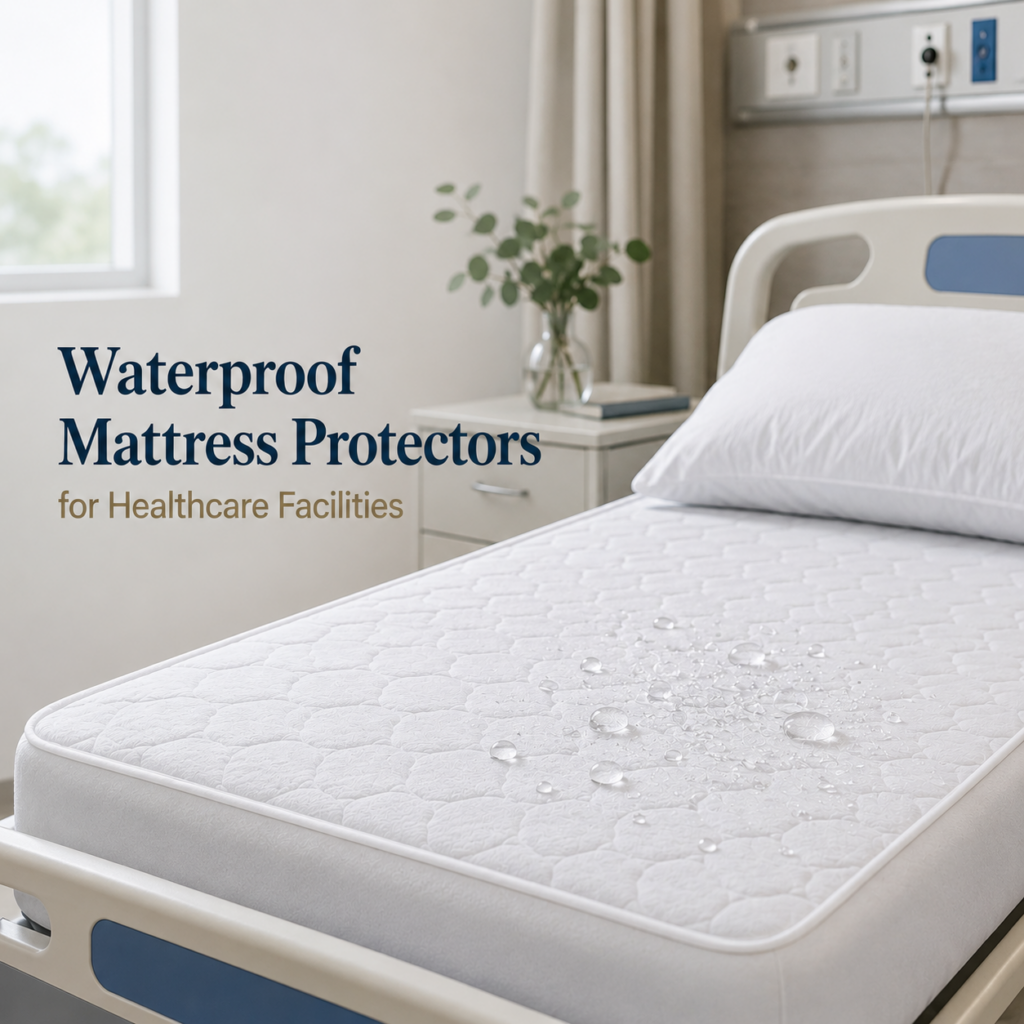
Healthcare mattress protectors balance fluid protection with comfort by using breathable barrier films, typically TPU rather than solid PVC, which block liquid while allowing water vapor to escape. This keeps the skin’s microclimate drier, reducing a known contributing factor in pressure ulcer development, without sacrificing the impermeability infection control requires. The right choice depends on matching barrier technology to patient risk level and care setting, not defaulting to the most impermeable option available.
Every healthcare facility needs mattress protectors that stop fluids cold. Incontinence, wound drainage, and spills cannot be allowed to reach the mattress core, both for infection control and because a contaminated foam or fiber core is effectively unsalvageable. That requirement is not in question. What procurement teams actually have to solve is a narrower problem: how to get that level of fluid protection without creating a hot, non-breathable surface that contributes to the skin problems the facility is also trying to prevent.
Why the comfort side of this is a clinical issue, not just a preference
Pressure ulcers develop from a combination of sustained pressure, shear, and moisture, and the moisture component is the one most directly affected by the bedding and protector fabric immediately against a patient’s skin. A skin microclimate that stays warm and damp, because the surface beneath the patient cannot release moisture vapor, is a recognized contributing factor in skin breakdown, particularly for patients who already have limited mobility and cannot reposition themselves to relieve pressure or air out a damp contact surface.
This is why current pressure ulcer prevention guidance, including the kind of clinical guidelines facilities are expected to follow, increasingly addresses moisture and microclimate management as a distinct factor alongside pressure redistribution, rather than treating fluid protection and skin comfort as separate, unrelated procurement decisions. A mattress protector is not just a barrier. It is part of the skin’s immediate environment for patients who may spend most of their day on that surface.
TPU versus PVC: the core material decision
Most waterproof mattress protector fabric for healthcare use is built around one of two barrier technologies. PVC, or vinyl, backing creates a fully impermeable layer that blocks liquid completely and is straightforward to wipe down and disinfect between patients. It is durable and inexpensive, which is why it remains common in lower-acuity and short-stay settings. Its tradeoff is that a solid PVC layer does not allow water vapor to pass through, which means heat and moisture from the patient’s body have nowhere to go.
TPU, thermoplastic polyurethane, backing is engineered differently. A properly constructed TPU film uses a microporous structure that blocks liquid water while still allowing water vapor molecules, which are far smaller, to pass through. This is the same basic principle used in breathable rainwear. The practical result for a healthcare mattress protector is a surface that stops fluid completely while still letting heat and moisture escape, keeping the skin’s immediate environment measurably drier than an equivalent PVC-backed protector over the course of a long period in bed.
Where the tradeoff actually matters in practice
For a short-stay, lower-risk patient, the difference between TPU and PVC backing may not be clinically significant, since the patient is mobile enough to reposition and the duration of contact is limited. The decision becomes considerably more consequential for long-term care, bariatric care, and any patient population with limited mobility or existing risk factors for skin breakdown, where the protector fabric is in sustained contact with the same skin area for extended periods.
Facilities serving primarily high-acuity or long-term patients increasingly specify breathable barrier technology as a default rather than a premium upgrade, treating it as part of baseline skin integrity protocol rather than an optional comfort feature. Facilities with more mixed or lower-acuity populations sometimes maintain both options, using breathable TPU protectors for higher-risk patients and standard PVC protectors elsewhere, balancing clinical need against the cost difference between the two technologies.
Fit and construction matter as much as the barrier film
A breathable barrier film loses much of its benefit if the protector’s construction traps moisture elsewhere. Fitted, contoured designs that stay securely positioned during patient transfers and repositioning prevent the bunching and shifting that can create localized pressure points and friction, both of which compound the moisture problem the breathable film is meant to address. Zippered encasement designs offer more complete coverage for higher-risk situations but need quality zipper construction and sealed seams to avoid becoming the actual point of fluid penetration.
Seam construction is a detail worth specifying explicitly rather than assuming. A breathable TPU panel with poorly sealed or unreinforced seams creates exactly the kind of leak point that defeats the purpose of choosing a premium barrier film in the first place.
Compliance requirements beyond fluid protection
Healthcare mattress protector fabric typically needs to meet several requirements simultaneously beyond basic waterproofing. Fire safety compliance is mandatory in most healthcare settings, particularly for bedding and mattress components. Compatibility with facility disinfection protocols matters as well, since some chemical disinfectants can degrade certain barrier films faster than others over repeated use, which affects expected service life and replacement frequency. Buyers should ask suppliers specifically how a given fabric performs under the facility’s actual cleaning chemistry, not just under generic test conditions.
OEKO-TEX Class 1 certification, the strictest tier covering products intended for sustained skin contact, is a reasonable baseline to require for any healthcare mattress protector fabric, given how much direct and prolonged skin contact this category of product involves.
Matching the specification to the care setting
The practical sourcing decision is rarely about choosing the single best protector fabric in the abstract. It is about matching barrier technology and construction to the specific patient population and care setting a facility actually serves. A acute care unit with high patient turnover and predominantly mobile patients has different priorities than a long-term care facility with a largely immobile, higher-risk patient population, even though both need fluid protection as a non-negotiable baseline.
Procurement teams who specify protector fabric based on actual patient risk profile, rather than defaulting to whichever option is cheapest or most familiar, are making a decision that affects both infection control outcomes and skin integrity outcomes, which is a wider impact than a basic bedding purchase usually carries.
If your facility is evaluating breathable versus standard waterproof protector fabric, we can send sample yardage of both TPU and PVC-backed constructions so your team can compare hand feel and breathability directly before specifying at scale.
Frequently Asked Questions
What is the difference between TPU and PVC mattress protector fabric?
PVC, or vinyl, backing is fully impermeable and blocks all liquid and vapor, while TPU backing uses a microporous structure that blocks liquid but allows water vapor to pass through, keeping the skin’s immediate environment drier over extended periods of contact.
Does mattress protector breathability actually affect pressure ulcer risk?
Moisture against the skin is a recognized contributing factor in pressure ulcer development, alongside pressure and shear. A breathable protector helps maintain a drier skin microclimate, which is one component of broader pressure ulcer prevention alongside repositioning and pressure redistribution, not a standalone solution.
Is TPU or PVC better for healthcare mattress protectors?
Neither is universally better. PVC offers full impermeability at lower cost and suits lower-risk, shorter-stay use. TPU costs more but provides breathability that matters more for long-term care, bariatric care, and patients with limited mobility who remain in sustained contact with the surface.
What certifications should healthcare mattress protector fabric have?
OEKO-TEX Class 1 certification, the strictest tier for products with sustained skin contact, is a reasonable baseline. Fire safety compliance is also mandatory in most healthcare settings for bedding and mattress components.
Why do seams matter on a waterproof mattress protector?
A breathable or waterproof barrier film loses its protective value if seams are poorly sealed, since seams are the most common point of fluid penetration regardless of how effective the main fabric panel is.